Hotels & Hospitality
Hotels & Hospitality Water Response
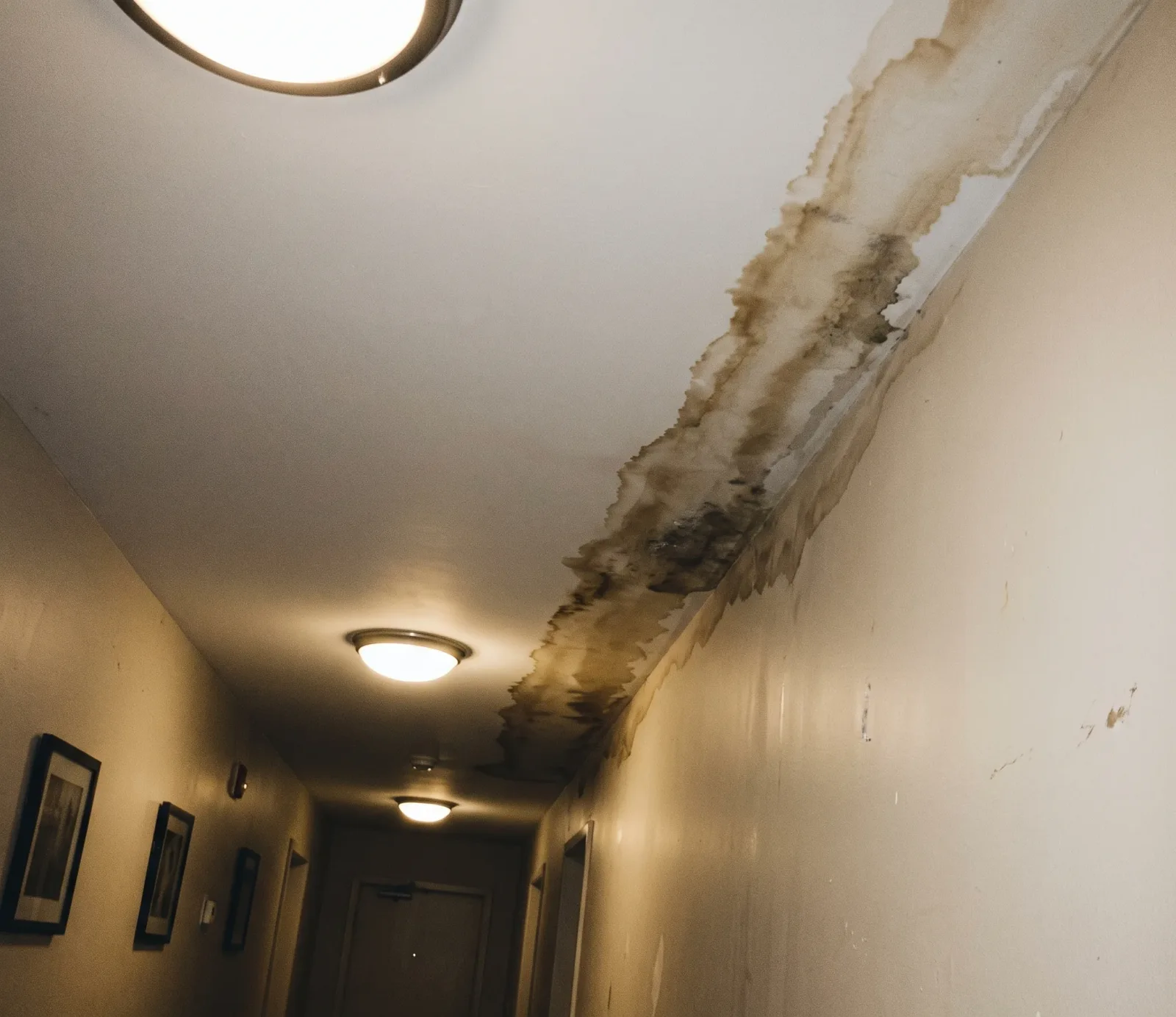
Shared walls, a riser that feeds several floors, and a leak intrusion that outruns one tenant's notice.
Multifamily water damage in Tempe is a leak, riser failure, or roof intrusion in one apartment that spreads to neighboring units through shared walls, corridors, and slab floors. With no basements to catch runoff, water travels sideways fast, so the licensed pros we connect you with check every adjacent unit, not just the one reporting the leak.
A pipe failure inside a Tempe apartment building rarely stays inside one unit. Slab-on-grade construction means water spreads across the floor toward whatever unit sits downhill, and a shared wall carries moisture sideways into the next tenant's space long before anyone notices a stain. Near Mill Avenue or Apache Boulevard, that speed matters more than the source.
Tempe's apartment stock splits roughly into two builds. Older complexes near Escalante or Holdeman route plumbing through wall cavities behind cabinets and closets, hiding a slow leak intrusion for weeks. Newer mid-rise towers near Hayden Ferry Lakeside route supply lines through shared chases and risers, so a failure on one floor can reach a unit two floors down before a property manager even gets the call.
An apartment loss in Tempe near Mill Avenue or the ASU campus rarely stays inside one lease. A single tenant can shrug off a slow drip for a day. A property manager watching water track into the unit next door, or drop through a shared wall into the corridor, has to act inside the hour, not the day.
A leak intrusion in one unit at a complex near University Heights or Riverside rarely ends at that unit's walls. Moisture travels sideways through a shared wall and downward through a riser, landing in whatever adjacent unit sits below or beside the source. Checking only the reported unit misses where the water actually settled, and that gap is where mold gets its start.
Empty units are the blind spot. A make-ready sitting vacant between leases near Hayden Ferry Lakeside or Riverside has the AC off and nobody checking it, so a supply line drip under a sink can run for days before a leasing agent or maintenance walk-through finds it.
| Building Area | Units Affected | How Fast It Spreads |
|---|---|---|
| Two-story, breezeway-style buildings | Leak crosses the breezeway floor below | Check the unit directly underneath first |
| Mid-rise near Hayden Ferry Lakeside | Interior corridors trap moisture, slow drying | Run airflow down the hallway, not just indoors |
| Buildings with one shared riser | A riser break floods every unit on the stack | Building management shuts the riser, not the tenant |
| Occupied units next to the source | Lease terms and tenant relocation slow the crew down | Coordinate access times through the property manager |
| Vacant or make-ready units | No one walks the unit until turnover | Put vacant units on a check schedule now |
| Lobby, stairwell, common area loss | Every resident crosses the wet spot daily | Dry around foot traffic, not around the schedule |
| Adjacent unit, shared wall | Water moves through the wall before drywall shows it | Test the neighbor's unit the same day |
| Older complexes, original plumbing | Slow leaks run inside the wall for weeks unseen | Read the wall cavity, not just the stain |
Every hour a leak runs in an occupied Tempe complex pushes building management closer to a tenant relocation call, and that call costs more than most repairs do. The source unit is only the start; moisture wicking through a shared wall or riser chase turns one bad valve into a multi-unit claim.
Vacancy changes the timeline in Tempe apartment buildings near campus, where units turn over every August as ASU leases end and start. A slow leak behind a washer in a unit sitting empty for cleaning can run for days before a new tenant moves in and finds warped flooring or a soft spot in the wall.
Tempe leans heavily rental, with ASU pulling in a steady stream of student and young-professional tenants near Mill Avenue and Apache Boulevard. That means a large share of the water calls the licensed pros we connect you with take in this city already involve a property manager, not a single homeowner standing in the driveway.
Wet flooring in a shared corridor or lobby is a hazard for every resident passing through, not only the tenant whose unit took the water. Property managers near Mill Avenue or Apache Boulevard complexes face that liability the moment common-area carpet or tile stays saturated.
A leak in a mechanical room or riser can knock out systems that serve more than one unit, so plumbing failure and building operations become the same problem. Monsoon-driven roof intrusion near Downtown Tempe can spread that reach even further, unit by unit.
Assessing a multifamily loss means tracing where the water actually went, not just drying the unit where it was first reported. That means checking the unit below for riser damage, the neighboring unit across a shared wall, and any corridor or stairwell the water crossed on its way through a building near Kiwanis Park or Papago Park.
Drying an occupied building near Tempe Town Lake or Kiwanis Park means running equipment around residents who still need their corridor, their stairwell, and often their own unit while the work happens. That is a different job than drying an empty house, and it takes more coordination with building management, not more chemicals or bigger fans.
Property managers calling about a Tempe complex near Hayden Ferry Lakeside or Warner Ranch usually ask how many units took water, not what one unit costs to dry. A leak that crossed a shared wall or dropped through a riser chase can mean several tenant conversations happening at once, not one.
None of that changes what has to happen first: stop the water and get drying equipment running before it spreads further through the building. Whether the source unit, the adjacent unit, or the association ends up paying for what can wait until the corridor near Riverside or Downtown Tempe is actually dry.
Make-ready windows near ASU are where a lot of hidden Tempe multifamily damage turns up. A unit sits empty for cleaning and paint between leases, and a slow leak intrusion behind a washer or under a slab-level cabinet goes unnoticed until the next tenant's walkthrough, by which time it's reached the subfloor.
Older brick homes near Maple Ash and Escalante sit low to the ground, while newer builds near Warner Ranch Village use standard slab construction with tighter vapor barriers. Both trap moisture differently once water gets under flooring or behind drywall near the slab edge.Downtown Tempe, West Tempe and The Lakes. A slab foundation near Mill Avenue reacts to water differently than one out by Kyrene Road, since caliche layers sit at different depths across Tempe. Where hardpan runs shallow, water pools against the slab instead of draining, pushing moisture up through flooring before anyone notices.
Triple-digit heat and monsoon humidity keep drywall and cabinetry damp long after a leak near Mill Avenue or Papago Park stops. EPA guidance says wet materials left past 48 hours risk mold growth, and Tempe's slab construction means that moisture travels sideways through flooring instead of down into a basement.A commercial loss near Tempe Marketplace or Arizona Mills typically dries slower than a house. Open floor plans, tile, and heavier equipment counts push costs up, so the licensed pros we connect you with quote these jobs separately from residential work. pricing guide, and the commercial overview covers how a scheduled program works.
Hotels & Hospitality Water Response
Restaurant & Food Service Water Damage
Commercial water damage, Tempe
A leak near Mill Avenue or Hayden Ferry Lakeside can move sideways along a shared wall or drop straight down a riser chase into the unit below before anyone reports it. Tempe's slab construction means ground-floor units and corridors take on standing water fast, so building management should check adjoining units immediately, not just the source.
Usually not, if caught fast. A supply line leak in one Tempe unit can stay put if crews shut the source quickly. A riser failure or a leak intrusion through a shared wall gives water a path into the adjacent unit before anyone smells trouble.
Often, yes. If the leak and the drying equipment stay inside one unit and the corridor stays dry, most tenants in that Tempe building can stay put. A riser or stack failure that reaches the hallway or a neighboring wall usually changes that answer.
That's a lease and building management decision first. Tenant relocation may be warranted if drying equipment has to run in an occupied unit for days, or if a common area everyone depends on is out of use.
Call now if a unit at your Tempe property is leaking. The licensed pros we connect you with can trace the riser chase and check neighboring units before the damage spreads past one lease.
Call (480) 681-1520